Driving Delivery Reliability
Transforming the checkbook ordering flow into a delivery-first experience that reduces failed shipments and operational costs.
Platform
IOS app
My Role
Research, ideation, prototype, end-to-end design
TEam
PM, developers, data team, UX writer


🎧
High volume of delivery-related support calls
Including delivery complaints, status inquiries, and requests to place pickup orders via the call center.
📦
10% of orders reported as undelivered (2,000 per month)
This resulted in check cancellations, fee refunds, and additional shipping costs.
🗣️
Low trust in the delivery process
During guerrilla testing, customers described feeling like “captive users,” citing the 14-day wait and risk of lost mail.
Main business problems
The problem
A Costly Cycle of Mistrust
At the time, customers could only receive checkbooks via Israel Post, free of charge. The PM and I suspected the mail-only delivery model was failing both the bank and its customers, so we set out to understand the gap between the digital flow and what customers actually needed.
The Challenge
Turning Insight into a New Delivery Method
Based on these findings, the decision was made to introduce a new pickup-point delivery method. The Product Manager led the tender process with a new logistics provider, while I led the experience design.
⏱️
Reduce banker handling time
💰
Reduce operational costs
🛡️
Restore trust
Business goals
The Challenge
Supplier Limitations & Product Constraints
The new logistics provider supported only city-based search and did not provide a map interface for pickup locations. This created a gap between the available data and the spatial context users typically expect when selecting a pickup point.
At the same time, building a custom map raised concerns about time-to-market. The team needed to launch the new pickup option quickly while still providing users with a clear and trustworthy selection experience.
To explore whether both goals could be met, I collaborated with an iOS developer to evaluate the native MapKit framework. We found we could build a lightweight map experience in-house without delaying the
Everything we solved started with asking structural questions
research
Before designing the new pickup option, I examined two core questions:
-
How should the flow handle the dependency between quantity and delivery method? Since certain quantities could not be ordered with all delivery methods, the structure had to prevent situations where an option simply did not appear — without explanation.
-
How can we enrich pickup selection when the provider only supports search by city? Limiting selection to city-based search reduced spatial context and weakened user confidence.
To solve this, I started by exploring two directions to address the dependency between quantity and delivery method: a traditional two-step flow and a combined one-screen approach.


System-filtered delivery options

Upfront dependency visibility
research
Competitor research
Beyond direct competitors like Bank Leumi, I also looked to leading eCommerce products such as local retail and delivery platforms.
From direct competitors, it became clear that pickup from collection points was still uncommon in the banking industry. Only one bank offered this option, embedding the supplier’s map via WebView directly inside the flow.
From the non-direct competitors, it was important to see how major players present pickup locations with spatial clarity, often using maps or distance indicators to increase user confidence.
This research shaped not only the interaction design, but also our understanding of the operational risks embedded in supplier-managed data.


Analysis
Making delivery the primary decision
The insights were clear:
-
Users cared more about the delivery method than the number of checkbooks. The delivery choice shaped their sense of control and certainty, while quantity felt secondary.
-
The design had to lower cognitive load, help users make an informed choice early, and make switching between delivery methods effortless.
-
Ownership over the pickup experience was critical. Some supplier solutions rely on WebView integrations or allow store managers to add free-text comments that appear directly in the app. This creates reputational and compliance risks. At the same time, market standards showed that users expect spatial context, such as maps or distance indicators.
These insights led to a third concept, which was tested and received especially positive responses from users.
The Challenge
One last guerrilla testing
I conducted one last guerrilla testing on the selected flow. The primary issue observed was that users could see pickup locations but could not clearly understand their own position relative to the stores. To resolve this, I added a positioning indicator component to strengthen spatial orientation and decision confidence. Follow-up testing confirmed improved clarity and faster decision-making.
Solution
Rebuilding Trust in Checkbook Delivery
I redesigned the journey to be Delivery-Centric:
Method-First Selection
Users choose their delivery method upfront (Pickup vs. Mail). This sets the right expectations for arrival times and costs immediately.


Map-based pickup selection
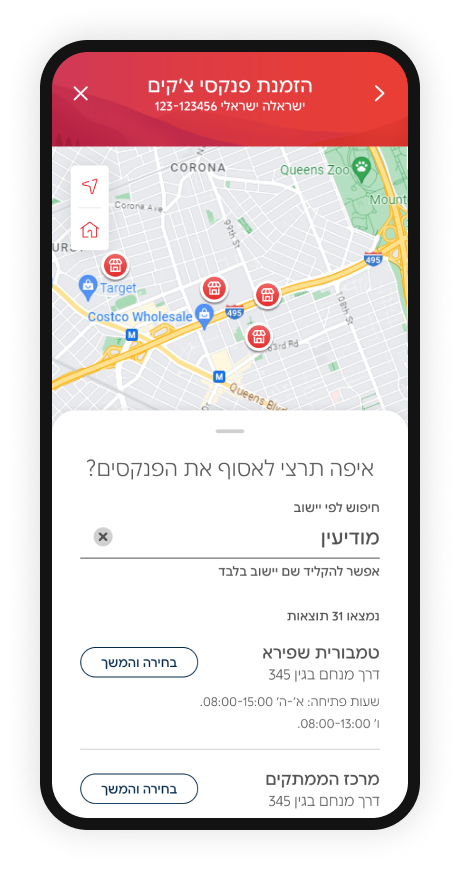
Because the supplier provided only city-based search, I designed a reusable map component that displays pickup locations with spatial context.
Features such as orientation controls and deferred location permissions help users quickly identify the most convenient pickup point.